
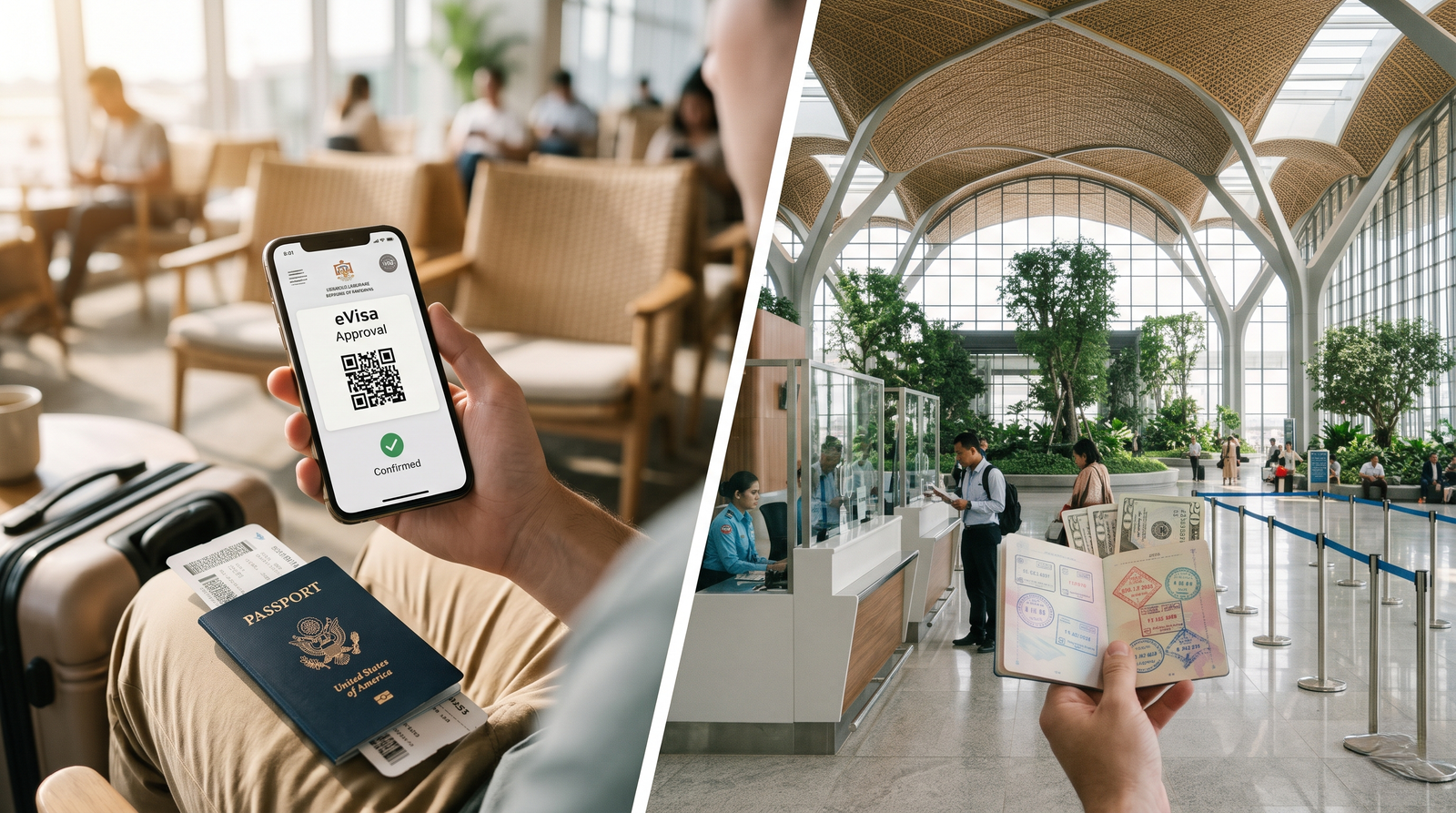
You are about to land in Siem Reap, a full day of travel behind you, and the immigration hall is already filling up. Some passengers walk straight through. Others join a long line at the visa counter, fumbling for cash and passport photos. The difference is usually a decision made weeks earlier: Cambodia eVisa or visa on arrival?
Both routes get you into Cambodia, and the government fee is the same. But they work differently, they are accepted at different entry points, and one of them can leave you stranded at the wrong border. This guide explains how each works, compares costs, and helps you choose.
The quick answer
- The government fee is identical: US$30 for a tourist visa and US$35 for a business visa, whether you apply online or on arrival.
- Choose the eVisa if you have fixed dates, a tight connection, or want your approval settled before you fly. It takes around three business days and works at three airports and two land crossings.
- Choose visa on arrival if your trip is last-minute, or you are entering at a checkpoint the eVisa does not cover, such as the Thai land borders.
- Either way, you also need the free Cambodia e-Arrival Card if you arrive by air.
Read on for the details, the entry points and a simple decision guide.
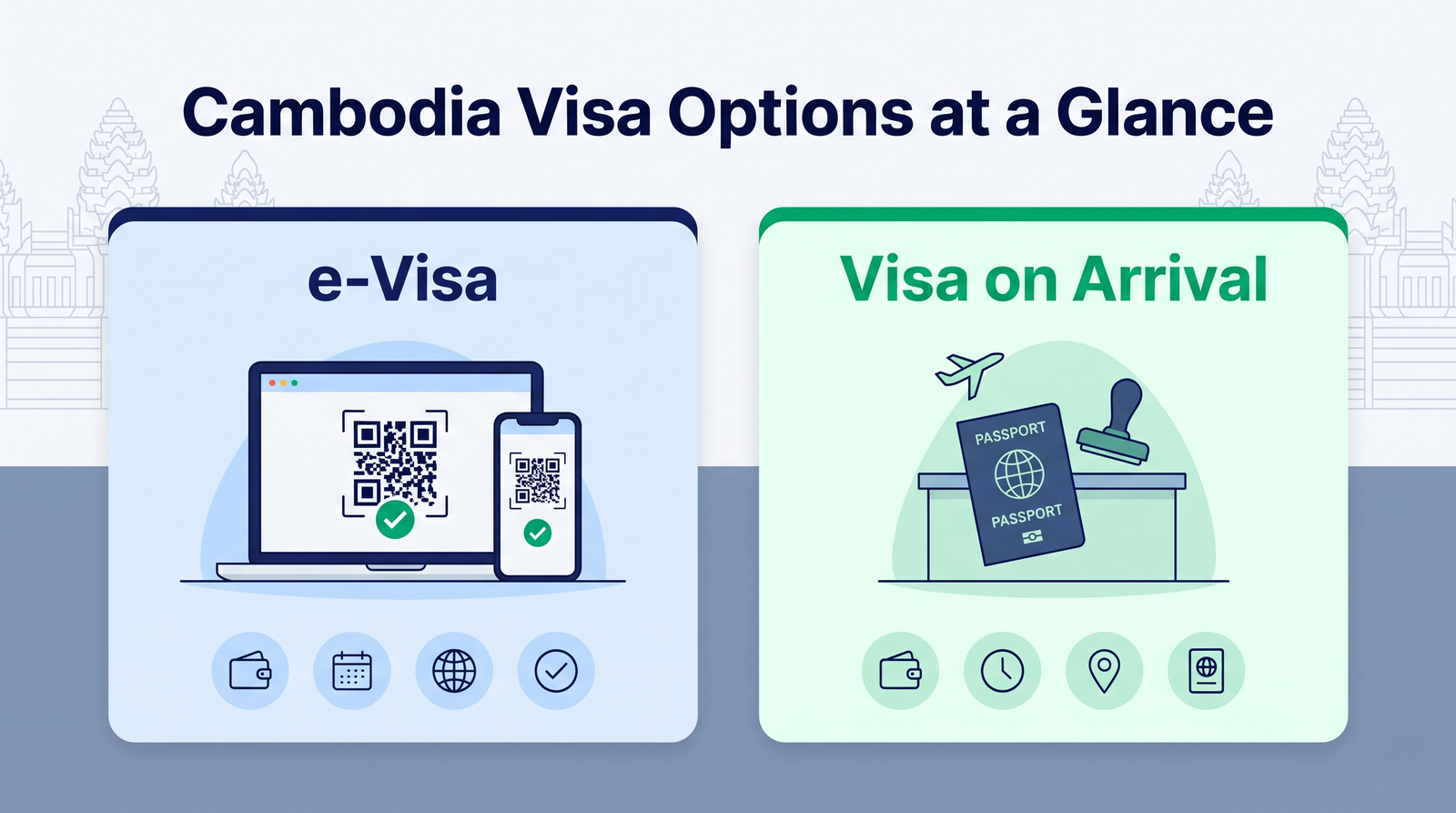
Cambodia Visa Options at a Glance
| Cambodia eVisa | Visa on Arrival | |
|---|---|---|
| Government fee | US$30 tourist / US$35 business | US$30 tourist / US$35 business |
| Stay | Up to 30 days, single entry | Up to 30 days, single entry |
| When you get it | Online, before you fly | At the border, after you arrive |
| Processing | Around 3 business days | Same day, after you queue |
| Payment | Online, in advance | At the border, usually in US dollars |
| Entry points | Three airports and two land crossings | Most open airports and land borders |
| Validity | 3 months from issue | Used on arrival |
How the Cambodia eVisa Works
The Cambodia eVisa is issued by the Ministry of Foreign Affairs and International Cooperation. It is a single-entry visa valid for three months from the date of issue, which gives you a 30-day stay once you arrive. The process looks like this:
- Apply online. Enter your passport and travel details and choose your arrival date and entry point.
- Upload your documents. Add a photo of your passport page and a recent photo of yourself.
- Pay online. You pay the government fee, plus our service fee if you apply with VistoRoute.
- Wait for approval. Processing takes around three business days.
- Receive your eVisa. It arrives by email as a PDF. Save it to your phone and print one copy.
Our Cambodia tourist eVisa guide and business eVisa guide cover the requirements in more detail.
How Cambodia Visa on Arrival Works
With visa on arrival, you show up at an open checkpoint, fill in a form, pay the fee and wait for your visa to be issued. The stay and fee are the same as the eVisa, but everything happens at the border. Many checkpoints also ask for a passport photo, so bring one in case.
The upside is flexibility: you do not need to plan ahead, and it works at more entry points than the eVisa, including the Thai land crossings that are currently closed to eVisa holders. The downside is that you handle payment, forms and queues after a long journey, and you only learn about any problem once you arrive.
Which Entry Points Accept the Cambodia eVisa?
This is the detail that catches travellers out. The eVisa is not valid at every border. It works at the following entry points:
| Entry Point | Type | eVisa Status |
|---|---|---|
| Techo International Airport (KTI), Phnom Penh | Airport | Accepted |
| Siem Reap Angkor International Airport (SAI) | Airport | Accepted |
| Sihanoukville International Airport (KOS) | Airport | Accepted |
| Bavet (Svay Rieng), from Vietnam | Land | Accepted |
| Tropaeng Kreal (Stung Treng), from Laos | Land | Accepted |
| Cham Yeam (Koh Kong), from Thailand | Land | Currently closed to eVisa entry |
| Poipet (Banteay Meanchey), from Thailand | Land | Currently closed to eVisa entry |
If you are travelling overland from Thailand, you will need a visa on arrival for now. You can leave Cambodia through any airport or border crossing. Because the list has changed before, always confirm the current entry points in our tourist eVisa guide before you travel.
Cost Comparison: Is the eVisa More Expensive?
Not in government fees. Cambodia charges the same amount for both routes:
| Visa Type | eVisa Fee | Visa on Arrival Fee |
|---|---|---|
| Tourist (Visa T) | US$30 | US$30 |
| Business (Visa E) | US$35 | US$35 |
If you apply with VistoRoute, your total is the government fee plus our service fee, which is calculated on the application form and shown before you pay. You are paying for specialist review, clear guidance, real-time status tracking and support, so your application is checked before it goes to the authorities. Our Cambodia visa fees guide shows the full breakdown.
You Need the e-Arrival Card Either Way
Whichever route you choose, Cambodia asks air passengers to complete the free Cambodia e-Arrival Card online within seven days before landing. It replaces the old paper immigration, customs and health forms and generates a QR code you show on arrival. It is not a visa, and it does not replace one. Have your passport details, flight number and your first night’s accommodation ready when you complete it.
What Happens at the Airport: eVisa vs Visa on Arrival
Here is how the two journeys usually look when you land at an airport such as Siem Reap or Phnom Penh. Exact procedures can vary by airport and time of day.
With an eVisa
- Walk to the immigration booths with your passport, your eVisa and your e-Arrival QR code ready.
- The officer checks your documents and may take your photo and fingerprints.
- Your passport is stamped, and you collect your bags.
With visa on arrival
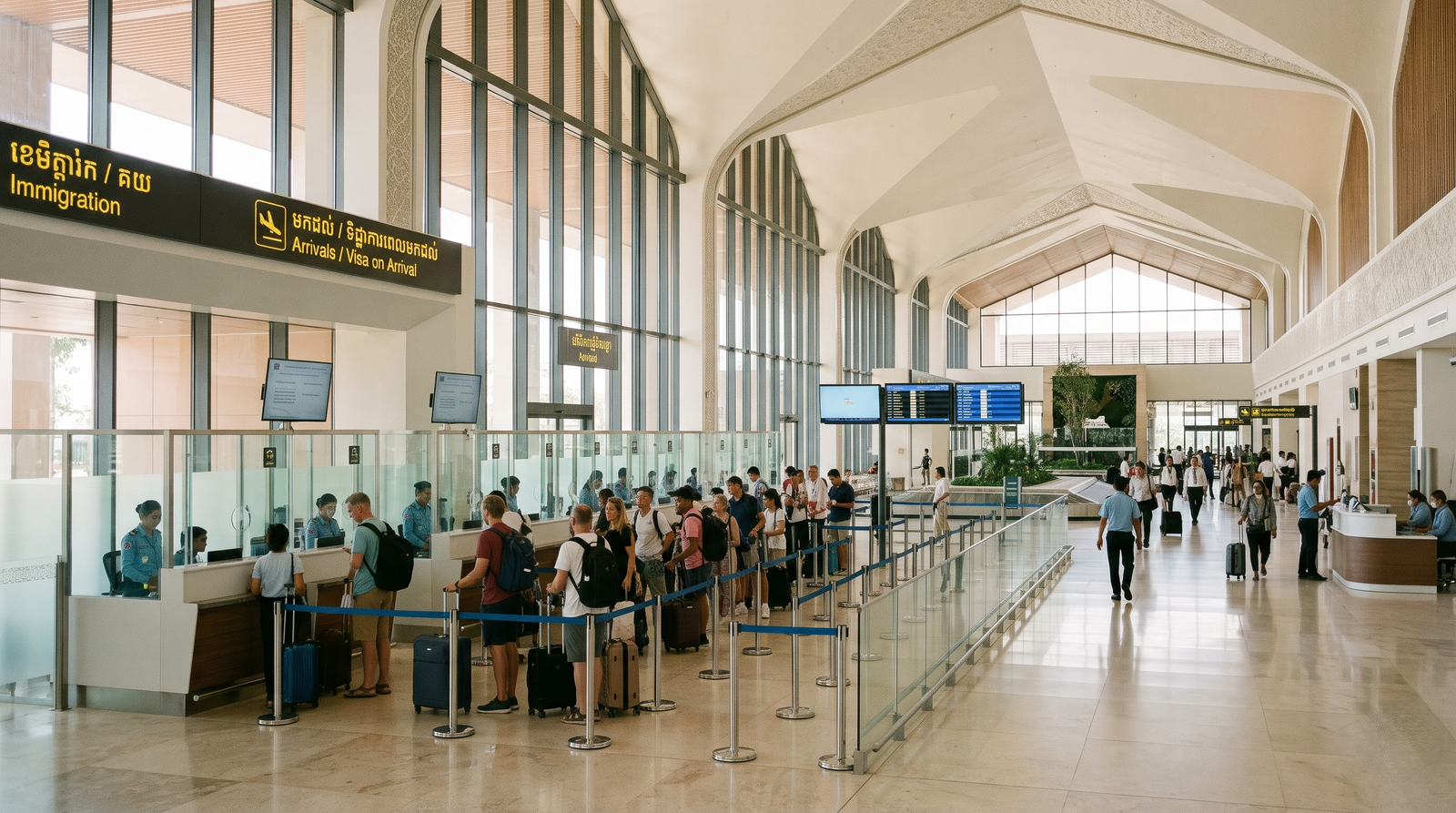
- Go to the visa counter first, fill in the form and hand over your passport, a photo and the fee.
- Wait for your passport to be called, with your visa attached.
- Join the immigration queue with your passport and e-Arrival QR code, then collect your bags.
The eVisa journey has one fewer queue and no cash payment, which is why travellers with tight connections or late arrivals tend to prefer it.
When Should You Apply for the eVisa?
Apply as soon as your dates are confirmed, and at least three business days before you fly. Remember that government offices follow Cambodian public holidays, including Khmer New Year in mid-April, Pchum Ben in September or October and the Water Festival in November. If your trip falls near one of them, give yourself extra time.
A Note on Fair Pricing
The government fee is US$30 for a tourist visa and US$35 for a business visa, so you should always be able to see what portion of your payment is the government fee and what portion is a service charge. When you apply with VistoRoute, the total is calculated on the application form and shown before you pay. Be careful about anyone asking for unexplained extra payments, whether online or at a border crossing.
Travelling for Business?
If your trip involves meetings, conferences or site visits, apply for the business eVisa (Visa E) instead of the tourist visa. The government fee is US$35, the stay is still 30 days, and you will need a letter of invitation from your Cambodian host. See our Cambodia business eVisa guide for the full checklist.
Pros and Cons
| eVisa | Visa on Arrival | |
|---|---|---|
| Pros | Approval before you fly No payment at the border Plan your route with confidence |
No planning needed Works at more entry points Good for last-minute trips |
| Cons | Needs about 3 business days Only valid at selected entry points |
Queues and paperwork on arrival Cash payment at the border Problems appear only at the counter |
Who Should Choose What?
| Your Situation | Best Route | Why |
|---|---|---|
| Fixed dates or non-refundable bookings | eVisa | Approval is settled before you fly |
| Tight connection or arriving late at night | eVisa | Skip the visa counter |
| Travelling with family or a group | eVisa | One calm online process instead of several forms at the border |
| Arriving overland from Thailand | Visa on arrival | The Thai crossings are currently closed to eVisa |
| Booking at the last minute (under 3 days) | Visa on arrival | The eVisa needs time to process |
| Citizen of an ASEAN country | Often visa-free | Stays of 7 to 30 days, depending on nationality |
Not sure what applies to your passport? Our Cambodia eligible countries guide shows visa-free, eVisa and visa-on-arrival groups.
Common Mistakes to Avoid
- Forgetting the e-Arrival Card. It is a separate free form for air arrivals.
- Choosing the wrong entry point. The eVisa works only at selected airports and land crossings.
- Applying too late. Allow at least three business days, plus a buffer for weekends and public holidays.
- Short passport validity. Your passport needs at least six months of validity and a blank page.
- Changing passports after approval. A new passport or changed details means the eVisa becomes invalid.
- Overstaying. Your stay is 30 days. Extensions are arranged with Cambodian immigration, so start early.
Cambodia eVisa vs Visa on Arrival FAQs
Is the Cambodia eVisa cheaper than visa on arrival?
No. The government fee is the same: US$30 for tourism and US$35 for business. The difference is when you get approval and where you pay.
How long does the Cambodia eVisa take?
Around three business days. Many applications are decided sooner, but the final timing depends on the Cambodian authorities.
How long is the Cambodia eVisa valid?
It is valid for three months from the date of issue and allows a single entry with a stay of up to 30 days.
Can I use the eVisa at the Thailand border?
Not at the moment. The Cham Yeam and Poipet crossings are currently closed to eVisa entry, so overland travellers from Thailand use visa on arrival.
Do I need the e-Arrival Card if I have an eVisa?
Yes, if you arrive by air. It is a free, separate online form completed within seven days before landing.
Can I extend my stay in Cambodia?
Tourist visas can typically be extended once, by 30 days, at a Cambodian immigration office. Start the process before your permitted days run out.
Who can enter Cambodia without a visa?
Citizens of ASEAN member states can enter for tourism without a visa for a limited stay, usually 7 to 30 days depending on nationality.
What do I need to apply for a Cambodia eVisa?
A passport valid for at least six months with a blank page, a photo of your passport page and a recent photo. Business applicants also need an invitation letter.
No comments yet.