
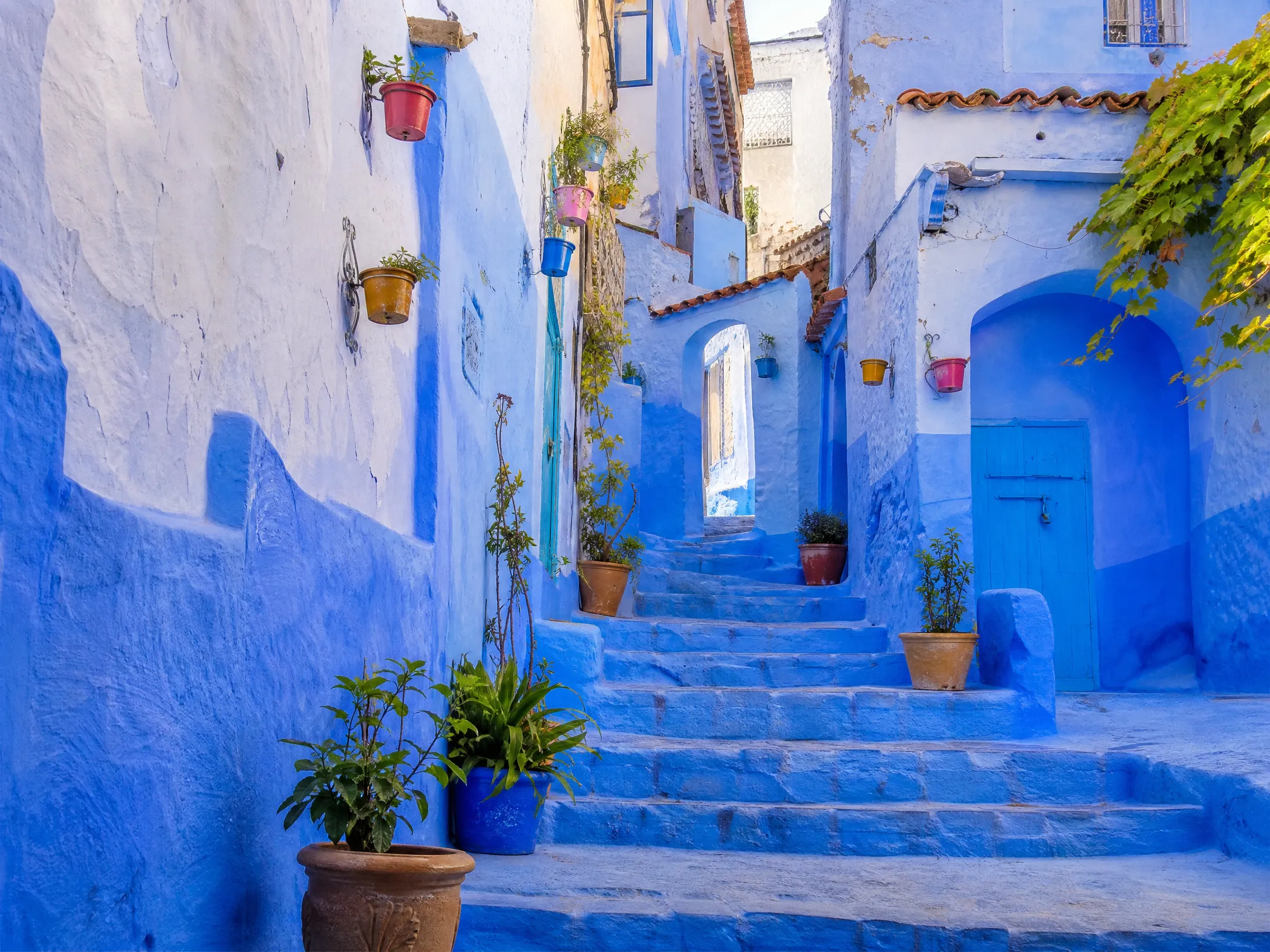
Nobody comes to Chefchaouen for the convenience of it. The town sits in the western Rif mountains at 600 metres, 113km and two hours from Tangier, and a stubborn four hours of mountain road from Fez. No rail line, no airport, no shortcut. That friction kept most of Morocco's history out of these hills, and it still filters the crowds better than any booking system.
A hidden town and its four centuries of closed gates
Locals call the town Chaouen, short for a name that means look at the horns, the two peaks standing over it like a matched pair of gateposts. The fortress dates to 1471, raised to keep an eye on Portuguese Ceuta down the coast. Then comes the strange part. For four centuries after that, outsiders were simply not let in. Christians, traders, map makers: all turned away at the gates. A hidden mountain town, opened only when Spanish soldiers arrived around 1920 and heard their own language already worn into the streets by descendants of Andalusian settlers. Shop shutters here post prices in Spanish before Arabic.
The Spanish garrison ran the place until 1956, which is why the twentieth century mostly telephoned instead of visiting. Politics never came up either, and the boulevards never happened. What the town received instead was a colour argument, inherited by every visitor on arrival.
Why everything is blue
Why the blue? Four explanations circulate, and I believe about one and a half of them. The favourite credits the Jewish families who arrived in waves, most recently in the 1930s, painting their quarter in the colour of sky and heaven as a daily nudge toward the sacred. An older version of the idea traces back to the 1492 expulsion from Spain. Then the practical school pipes up. Mosquitoes take blue walls for water and mind their own business elsewhere, and pale walls keep July out of the rooms as a bonus. My favourite version remains the town rumour: some office in the 1970s made the blue compulsory and never bothered to explain why. Whatever began it, residents repaint twice a year and never one shade of bucket. Young washes photograph turquoise. Coat number ten ages a wall into denim, and the hallway on the way down, doors painted across three decades, wins the award nobody runs.
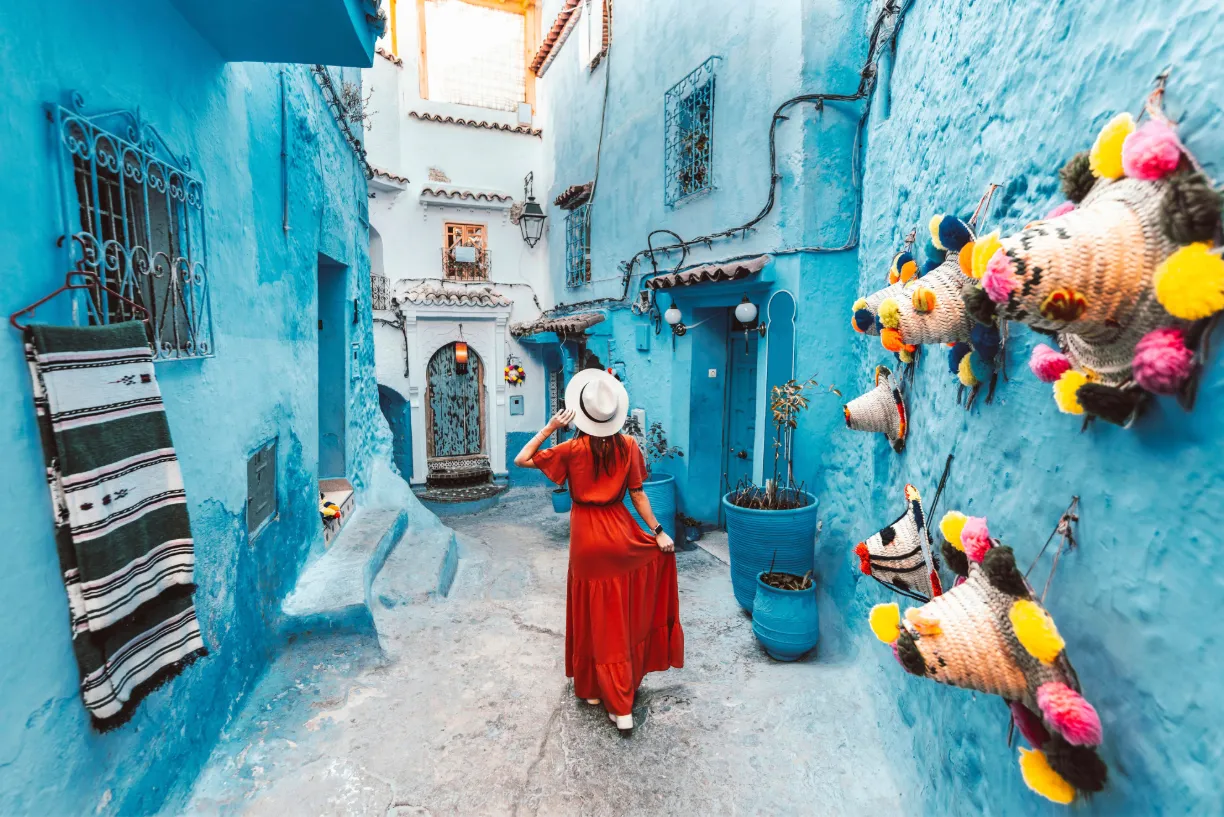
Rail? None. The Fez bus: four hours through the olive country, snow at the pass in winter, and a driver who collects oranges from a roadside sack through the window, commission two. Tangier does the drive in about two, Tetouan faster still, and grand taxis patch the timetable gaps at every village. The map app will sell you a morning departure. Ignore it; the eleven o'clock wave of tour coaches lands at the gate exactly when your bus does. An evening arrival gets the lanes to itself plus the first blue hour, and no extra charge was ever discussed.
The medina at walking speed
The wall-fashion trade runs on two coats a year: one in spring, one in autumn, with half the town painting for the other half and no paperwork anywhere. My first morning had a painter at work on a lane too narrow for his ladder, blue sleeves to the elbow, and a boy at the gate selling oranges who counted my coins twice and refused the tip once. Bab Souk's stairways, geranium pots, three decades of paint on one doorframe: half an hour covers the map, and a morning covers the good version. Uta el-Hammam square runs the noise from eight o'clock, grills and chess and school runs, with the 1471 kasbah across the way refusing the blue in stubborn red ochre. Its rooftop handles the geometry lesson. The entire grid, blue on blue, one Andalusian garden shading the museum side, and a school of cats holding the steps.
The houses end at the north side and the water begins there. Ras el-Maa, the head of town, cold and loud, where rugs and school uniforms go flat against the rocks each day, the strokes coming straight from the grandmothers' generation. Children stood waist-deep for an hour and shrieked at nothing in particular. A shepherd dog defended the best drinking pool from two cats and lost interest instantly. Follow the water downhill and the blue simply ends, whitewash, bare stone, the old mills holding their dead wheels. Locals walk past at full speed. My five unsold minutes there beat most attractions I paid for in this country.
The Spanish Mosque, and why evenings end on the ridge
Evening plans write themselves. East gate, dirt track, half an hour uphill: the Spanish Mosque on the Bouzaafar ridge. Spain began it in the 1920s and abandoned the job, and the grass finished the doors instead. Nobody prays there now. Everyone watches. From its low wall the medina stacks up in blue on whiter blue, the twin horn peaks standing sentry behind it. The light flips from grey to copper to gold inside one glass of mint tea, the adhan rises up from beneath your boots, and the wind keeps everybody honest. Take the jacket. Then sit through all three colours anyway. The walk back down takes ten minutes and feels illegal at that price.
Akchour: the day the trails argue
Akchour swallowed our entire second day and paid the bill back within one hour. The grand taxi left town with five of us aboard, thirty kilometres of cedar and fir, and stopped at a small hydro dam where the trails immediately disagree over direction. My half chose the Grand Waterfall, a morning out, terraces of cold water stepping into pools exactly the green of the Oued Farda in March, and a village dog adopted us at the trailhead, disputing our swimming rights for the best part of an hour. The other halves of the hotel party turned right at the dam toward God's Bridge, an hour of switchbacks to a limestone arch hung over the canyon, and came home describing it in the tone people reserve for births and weddings. Barbary macaques ran commentary from the canopy the whole day and audited one lost sandwich wrapper with forensic care. A single fisherman shared our midweek valley, and he looked almost affronted by the company.
Food, wool and the price of patience
Cooking follows the morning catch, and the rooftop cafe over the wool lane still runs the same three-generation trout recipe. Msemen comes off the griddle with honey and olives; the goat cheese takes a red tray and a doorway where nobody names the price first. Lunch asks one question every time, namely what my plan is for the afternoon. Two handlooms keep thumping Rif rugs in cream and blue, with blankets stacked for winter. The price is the price; one quote, honest enough, delivered while she keeps knitting.
When the valley works hardest
October, my second visit, behaved perfectly: mid-twenties at noon, cool enough for a jacket at breakfast, the Akchour falls still running. Spring had brought everything green with rain at nightfall and lambs in the fields, and the words of local hosts about May made it sound like the town's high season of waterfalls. July and August hand the lanes to the coast buses, the crowd peaks at lunchtime and gives everything back by six, just as the light gets smart. Winter keeps the town to itself, cedars in snow on some mornings, and radiators generous enough to write a diary next to.
A two-day ledger
Two days covered the ledger, and a third had to be negotiated with my own calendar. A Thursday evening arrival missed the ridge by minutes; dinner ran soup, skewers, tea, and the guesthouse lane identified itself by smell alone. Mornings had the camera. Afternoons had Akchour. Nights closed on rooftops and closing shopfronts, and the dog by the bakery still greets me from three hundred metres. That dog has better recall than most consulates.
What it costs
Money conversations here stay short. My second guesthouse ran 350 dirhams for a room over the next roof with a grandmother attached who confiscated my laundry twice, and simpler rooms ask half of that. Breakfast with cheese runs under 40 dirhams; trout with tea about 60 to 80. Akchour guides ask 250 to 400 for the day, and the taxi from Fez, split four ways, cost less than that trout. Cards stop working past the square. Small notes plus a money belt left to its own devices cover the weekend.
The visa step, done cheap
One admin step before riad deposits: entry rules. Passport by passport, Morocco is visa-free, covered by an online tourist eVisa, or consulate territory - the visa-exempt list settles your case in a minute. The eVisa overview explains the requirements and the 3-step walkthrough shows the whole form answered field by field. The paperwork costs one laptop and ten minutes, and riad deposits should wait for it. Route-planning help exists too: the 10 best places to visit in Morocco in 2026 places this town beside Marrakech, Fez and the coast, and the Sahara desert tours from Marrakech and Fez pair dune nights with these mountain days.
Frequently asked questions
Why is Chefchaouen blue?
Two paint shops, two stories, collected in one afternoon. The shop near Bab Souk swears the blue arrived with the Jewish families, first from Spain in 1492, then the waves of the 1930s, washing their quarter in the colour of sky and heaven. Mosquitoes, said the other shop, take blue walls for water and mind their own business elsewhere. I bought lime at both, and the schedule matched without a rehearsed answer: twice a year, spring and autumn. That is also why no two blues match. Every painter is restoring a different memory of the original.
How many days do you need in Chefchaouen?
Two nights, minimum. The first evening covers the ridge and the square, the second morning covers Akchour, and that trip is half the reason to come this far north. Drivers from Fez compress it into one frantic day, but four hours of road each way turns the town into a carpark photo stop, which is a waste of the petrol. Send three nights whenever a hammam or a lazy rooftop is on the wishlist. Nobody has ever regretted the third night here.
Can you do Chefchaouen as a day trip from Tangier?
The tour desks sell it: 113km, more or less two hours each way from Tangier, and the coaches stand at the gate by eleven. What the day trip skips is the evening, when the lanes return to their residents. Two workarounds exist, a late return for one blue hour, or a night's stay, which turns the medina into a neighbourhood instead of a film set. My vote costs exactly one booking.
What is the best month to visit Chefchaouen?
Two visits taught me most of it. October behaved and the falls kept flowing; May, on every local account, brings the valley at its fullest. June peels the crowds off as school ends. July and August buy you heat, tour buses and a lunchtime queue for the same thirty doorways, though the mornings keep their manners. Winter offers the streets at my favourite price, empty, plus snow on the cedars some mornings and a radiator bill for somebody. May weekends book early, predictably as trains.
What should you wear in Chefchaouen?
Knees and shoulders stay covered here, as in any Moroccan small town, and a scarf rides in the bag for mosque doors. One camera rule covers the town: ask first. The yes, when it comes, carries a grin. Friday afternoon stops for midday prayers; shops empty, and the square dresses up by evening. Stairs outnumber every other feature of the town, so shoes get considered before scarves.
Is Chefchaouen safe for solo travellers?
The town sleeps before you would, and pitching it against the cities is not close. My morning shift had a single supervisor, a helper with directions that ended, reasonably, at his family's jewellery shop, and warm manners declined him in ten seconds. Solo women told me the late lanes pass uneventfully, shops shut at dusk, and streets keep their residents past midnight. Stairs will catch you before any person does. Wear boots.
Planning the Rif next? The Morocco tourist eVisa application runs fully online, and the 3-step guide walks the form end to end. Sort the entry rules first, then let the blue city argue the rest out.
No comments yet.