

On this page
Quick answer
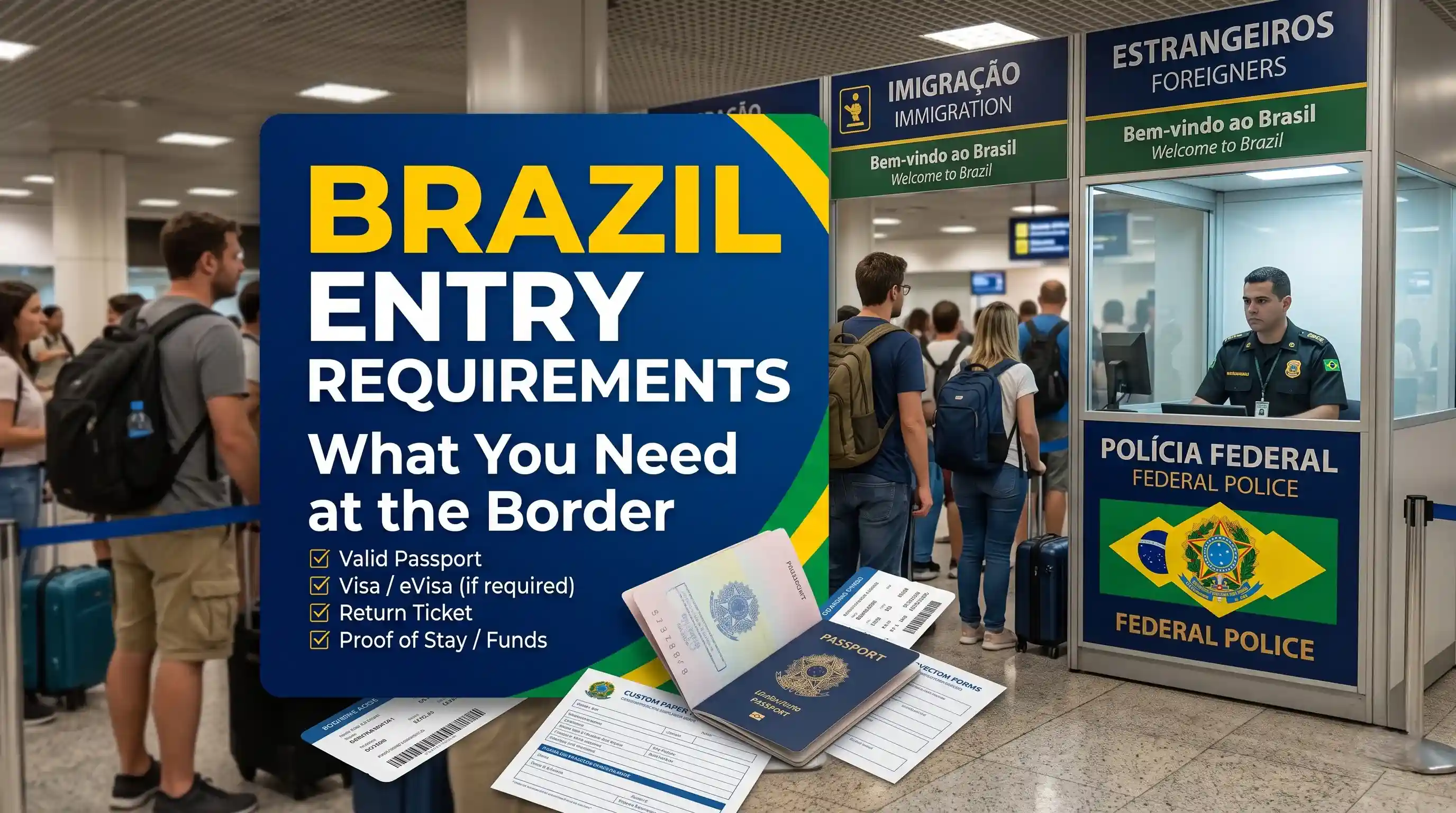
Your passport, an eVisa if your nationality needs one, and a folder with your return ticket, accommodation and funds proof is the core of Brazil's entry requirements. The Federal Police decide entry at the border and may ask for those documents even with a valid visa. Customs adds the e-DBV: file it online if you carry more than US$10,000 in cash or goods beyond the US$1,000 duty-free quota. No vaccination is required to enter Brazil, but yellow fever shots are recommended for most of the country and matter for some onward countries.
What Happens at the Border on Arrival
Landing in Brazil puts you through two separate checks with two different authorities, and they run back to back. Knowing which desk decides what keeps the morning simple:
Two separate checks
Immigration is handled by the Federal Police, who decide whether you enter the country. Customs, run by the Receita Federal, comes after you collect your baggage and decides what you bring in. Different desks, different rules.
The entry decision is the officer's
Brazil's foreign ministry states it plainly: a visa is an expectation to be admitted, not a right. The Federal Police officer at the desk makes the final call, visa in hand or not.
Questions you may be asked
Purpose of the trip, where you are staying, and how you will pay for the stay. Officers can request accommodation proof, your itinerary, travel insurance or invitation letters before letting you through.
Get your entry stamp
Watch the officer stamp your passport before you leave the desk. The stamp is your proof of legal entry and the date your permitted stay starts, and travel authorities warn an unstamp passport can cause fines when you leave.
One more border case sits apart from all of this: if your connection never leaves the international transit area, different rules apply entirely, covered on our Brazil transit eVisa page.
Passport Rules at Entry
The passport rule at the border is simpler than most people expect, and it differs from the rule for the visa application itself:
- Official validity rule
- The passport must be valid on the entry date and stay valid through the whole trip until your departure day. Brazil itself asks for no extra months beyond that
- Blank pages
- Keep at least two blank pages, since Brazil stamps both on entry and on exit
- The airline curveball
- Some airlines apply a stricter six-month check at the check-in counter, even though Brazil does not require it. Confirm your carrier's own policy before you fly
- Old visa, new passport
- A visa sitting in an expired passport still works if your name is unchanged: carry both passports together at the border
Application rule vs border rule: the one-month-past-departure validity people see on eVisa application pages applies to the application review, not to entry. At the border it is valid-through-stay that counts. The full picture of both sits on our Brazil eVisa eligibility guide.
Documents Officers Can Ask You to Show
Brazil's foreign ministry is direct about this: the Federal Police may request supporting documents before allowing entry, even when you hold a valid visa. None of these are demanded of every traveler, but any of them can be asked for, so keep them ready in one folder, printed or as offline PDFs:
- Return or onward ticket showing you leave Brazil inside your permitted stay
- Proof of accommodation, a hotel booking or a host's address with a letter
- Proof of sufficient funds for the stay, bank statement or cards you travel with
- Trip itinerary with your internal flights or bus tickets inside Brazil
- Travel insurance and evidence of your trip's purpose, including invitation letters for business visits
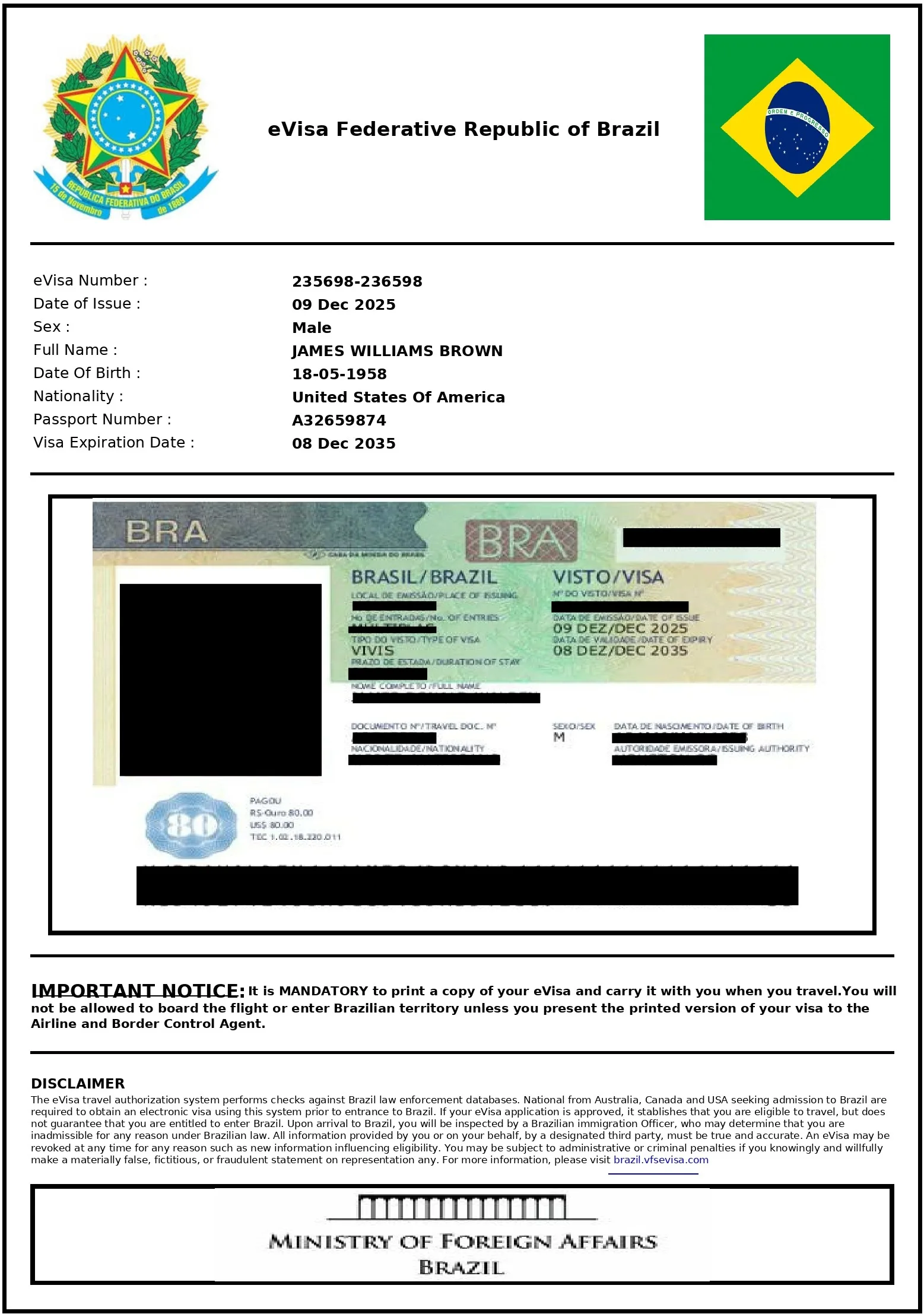
The documents you prepare before travel, photo, passport scan and purpose proofs, live on our Brazil eVisa requirements page. Whatever your nationality, the tourist entry rules are explained on the tourist eVisa guide.
The e-DBV Customs Declaration
The e-DBV is Brazil's electronic traveler's declaration, run by the Federal Revenue (Receita Federal). It replaces the old paper customs form and exists for one purpose: declaring cash and goods that fall outside the duty-free rules. Four steps cover most trips:
Check whether you must file
Filing is mandatory when you carry more than US$10,000 in cash or equivalent in any currency, goods beyond the duty-free quota, restricted items such as medicines beyond personal use, or equipment worth over US$3,000 that you will take back out. Under those lines, there is nothing to declare.
File online before you fly
The declaration opens on the Receita Federal's site up to 30 days before travel, with drafts you can save and edit until transmission. Self-service terminals at Brazilian airports handle it on the day for travelers who did not file in advance.
Pay any duty in advance or on the spot
Excess goods are taxed at a flat 50% import rate on the amount above the quota. The system prints a payment slip you can pay from home banking before landing, which speeds up the desk; if you are waved through, tax on exempted goods can be settled within 30 days after entry.
Show the receipt at the right channel
After baggage, pick the green nothing-to-declare lane or the red goods-to-declare lane. The e-DBV receipt, printed or on your phone screen, goes to customs at the red lane, along with the goods and cash themselves if asked.
The penalty math: walking through the green lane while carrying declarable goods counts as a false declaration and costs a 50% fine on the excess value. Undeclared cash above US$10,000 can lose the entire excess amount, not just owe tax on it. Filing the e-DBV is free and takes minutes.
Duty-Free Allowance and Taxes
Every traveler gets a personal goods allowance, and it resets once every 30 days. The numbers differ only by how you arrive:
| Situation | Allowance |
|---|---|
| Arriving by air or sea | Goods worth up to US$1,000 duty free |
| Arriving by land, river or lake | Goods worth up to US$500 duty free |
| Personal-use items | Clothing, hygiene products, books and your own used electronics sit outside the quota entirely |
| Arrival free shop purchases | An extra US$1,000 at the first Brazilian airport's free shop when arriving by air or sea |
| Anything above the limits | A 50% import tax charged on the excess value, declared through the e-DBV |
Quantity caps sit alongside the money limits: 12 liters of alcohol in total, 10 packs of cigarettes, 25 cigars and 250 grams of tobacco, all counting toward the quota. Three rules catch people off guard: the allowance is personal and cannot be pooled with a travel partner's, even family; it applies once per 30 days, so a second trip inside the month gets no fresh quota; and alcohol or tobacco cannot travel in a minor's luggage at all.
Yellow Fever and Health Rules
Health rules split in two directions, and travelers who only read half of them get caught at the wrong airport:
Entering Brazil
- No vaccination certificate is required, a rule in place since 2008
- Yellow fever shots are still recommended for most states, including Rio de Janeiro, Sao Paulo, Brasilia and the Amazon region
- Get the shot at least 10 days before travel for it to count, and do it at home, since vaccine supply inside Brazil is limited
Continuing onward
- Bolivia, Colombia, French Guiana, Guyana, Paraguay and Suriname may demand proof of vaccination from travelers arriving from Brazil
- The yellow card certificate stays valid for life since 2016, so one shot covers every future trip
- Amazon-bound travelers should also ask a doctor about malaria prevention, since the risk is real in those states
Onward country rules change without much notice, so check each country on your itinerary before flying rather than relying on what applied on your last trip.
Restricted and Prohibited Items
Customs works with several federal agencies, and each one can stop an item that seems harmless in a suitcase:
Frequently Asked Questions
Do I need a visa to enter Brazil?
It depends on your nationality. US, Canadian and Australian passports, plus the nationalities added to the eVisa list in 2026, need an approved eVisa before flying, while many other passports enter visa-free for short stays. Our Brazil eVisa eligibility guide and the visa-free countries list tell you which group you fall into before you book anything.
How long can I stay in Brazil?
Visitors typically receive up to 90 days per entry, and the same 90-day allowance applies to eVisa holders. If 90 days is not enough, the stay can be extended in country up to a maximum of 180 days per rolling 12 months; the Brazil visa extension guide covers that process.
Do I need an onward ticket to enter Brazil?
You may be asked for one. Brazil's migration rules allow the Federal Police to request proof of your transport out of the country and funds for the stay, and airlines commonly check for a return or onward booking at check-in. Carry a confirmed booking that leaves Brazil within your permitted stay.
What is the e-DBV declaration?
The e-DBV is Brazil's electronic customs declaration, filed online before you travel or at self-service terminals on arrival. It becomes mandatory when you carry more than US$10,000 in cash or equivalent, goods beyond the duty-free quota, or restricted items such as medicines beyond personal use. The receipt, printed or on your phone, is shown at the red channel after you collect your baggage.
How much can I bring through Brazil customs duty free?
Goods worth up to US$1,000 are duty free when you arrive by air or sea, and US$500 by land. Personal-use items like clothing, hygiene products and books sit outside that quota entirely, and the arrival free shop adds another US$1,000. Above the limits, customs charges a 50% import tax on the excess.
Do I need a yellow fever vaccination to enter Brazil?
No. Brazil has not required proof of yellow fever vaccination for entry since 2008, and no other vaccines are required either. Vaccination is still recommended for most of the country, including Rio de Janeiro, Sao Paulo, Brasilia and the Amazon region, ideally 10 days before travel. Countries such as Bolivia, Colombia, French Guiana, Guyana, Paraguay and Suriname may ask for the certificate if you continue onward from Brazil.
Can I be refused entry with a valid visa?
Yes. Entry is decided by the Federal Police at the border, not by the visa alone, and officers can ask to see your accommodation booking, itinerary, funds or invitation letters before admitting you. Carry those documents in an accessible folder, digital or printed, for both entry checks and any checks during your stay.
VistoRoute is an independent visa information and facilitation platform and is not affiliated with the Government of Brazil or any consular authority. We help travelers understand eligibility and prepare accurate applications, but all final decisions on visa issuance rest with Brazilian immigration authorities. For official government guidance, always cross-check with your nearest Brazilian consulate.