
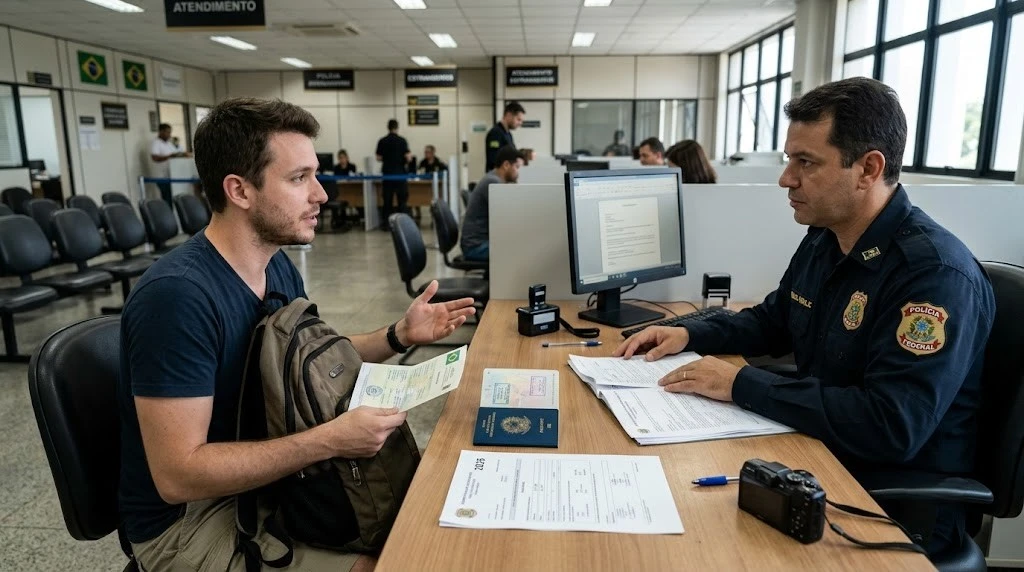

Quick answer
Most visitors extend a stay at a Federal Police office in Brazil before their first period expires: pay the GRU fee (about R$110 in 2026), bring your passport and entry details, and attend a short interview. You can usually add up to 90 more days, to a cap of 180 days per rolling 12 months. Some passports, most Schengen ones included, cannot extend at all.
How the Brazil Visa Extension Process Works
An extension is a request you make after you land, not another visa application. You are asking the Federal Police to lengthen the stay printed on your entry stamp, and they decide based on your documents, your reason for staying longer and your travel history. Nothing about your multiple-entry eVisa validity changes, only the days you are allowed to remain this time.
- Initial stay
- Up to 90 days from your entry stamp for most visitors. The stamp shows the exact date by which you must leave, and that date is the one that matters
- Extension
- One request per entry, filed before the original deadline, assessed case by case rather than granted automatically
- Yearly cap
- 180 days in total within any rolling 12-month period, counting every entry you make
- Where
- A Federal Police immigration unit inside Brazil, in person. There is no online extension form and no extension route at the airport
- If you already left
- An extension cannot be requested from abroad or after you depart. Once the deadline passes, the conversation becomes a fine instead
Two different clocks: your visa's validity is the window in which you may enter Brazil; the stay is how long you may remain after each entry. Extending changes the stay, not the visa. And the 2026 fee figure (R$110.44 on the published schedule) is paid through a GRU payment slip, which you generate online, print and pay before your interview.
Practical timing: start around two weeks before your stamp deadline, not on the final day. Unit backlogs, payment clearance and missing paperwork all eat days, and a request filed after the deadline is no longer an extension at all.
Who Can and Cannot Extend a Stay in Brazil?
Brazil matches extension rules to your home country's own treatment of Brazilian travelers, which is why the answer differs by passport. Here is the honest split:
Usually can request one
- eVisa holders from the United States, Canada and Australia, on a standard 90-day entry
- Most other visa-free passports that arrived under the standard waiver rules
- Anyone whose entry stamp shows a 30, 60 or 90-day period, as long as the request lands before it ends
- Travelers still under their yearly total of 180 days across all trips
Usually cannot extend
- Most Schengen-area passports, capped at 90 days per 180 on reciprocity grounds, with Iceland, Liechtenstein, Norway, Poland and Portugal listed as exceptions in official guidance
- Anyone who already used 180 days in the current 12-month window
- Requests made after the deadline, which the Federal Police treat as an overstay rather than an extension
- Anyone planning to work or settle in Brazil, since that needs a different visa category altogether
Reciprocity tables get updated, so treat this as the shape of the rules rather than a ruling on your exact passport. If your trip depends on extra time, check your status on the Brazil visa-free countries list and confirm with your local unit before you plan around an extension. Our eVisa eligibility guide covers which passports needed approval in the first place.
Brazil Visa Extension Documents and Fee
Officers can ask for anything tied to your trip, but these are the items that come up every time. Gather them the week you decide to extend, not the morning of your interview:
- Your passport, valid for your whole planned stay, plus the entry stamp or entry card showing your current deadline
- The paid GRU receipt, generated from the official payment slip for the extension fee, roughly R$110 in 2026 (check the amount on your own slip)
- Proof of accommodation, a hotel booking or an invitation letter with the host's address
- Proof of funds for the extra weeks, recent statements or card records that show you can cover the longer stay
- Your onward or return ticket, dated inside the extended period you are asking for
- A short reason for staying longer, in plain words: family help, medical treatment, a project running over. Officers ask, and a clear answer keeps the interview short

On the fee: the extension charge is separate from the Brazil eVisa fee you paid before traveling, and it sits on its own GRU slip with its own collection code. Amounts get updated, so print fresh and read the figure on the slip rather than any figure you saved earlier.
How to Extend Step by Step at the Federal Police
Five moves take you from your entry stamp to a decision. The sequence matters more than the speed:
Read your deadline on the entry stamp
The date written by the officer on arrival is your real deadline, whatever your visa says. Put a reminder a full two weeks ahead of it. If the stamp is missing or unreadable, sort that first, because an unregistered entry creates problems on exit.
Generate and pay the GRU slip
The extension fee is collected through a GRU payment slip, which you generate and print before your appointment, then pay through a bank or payment app. Keep the stamped receipt, since the interview starts by checking it. The published 2026 figure is roughly R$110, but your slip shows the amount that applies.
Book your unit's slot, if it wants one
Some Federal Police units run strictly on online appointments, others take walk-ins during immigration hours, and a few do both depending on the day. Check your local unit before you travel across the city, and go earlier in the week when queues are usually shorter.
Attend the interview with your documents
Bring the folder from the section above. The interview itself typically runs about 20 minutes: purpose of the longer stay, where you are staying, how you are funding it, when you leave. The official service estimate allows up to 72 hours in total, which includes the bank clearing your payment.
Get the decision and check your new date
If approved, your permitted-departure record is updated, usually annotated on or alongside your passport. Read the new date before you leave the building. If the answer is no, plan your exit inside the original deadline rather than hoping the refusal disappears.
Still deciding whether an extra month is even worth it? Our Brazil tourism eVisa guide covers what fits inside a standard 90-day trip, and how to apply for a Brazil eVisa explains the pre-travel side if you are still planning the original entry.
What Happens If You Overstay Your Brazil Visa?
Missing the date does not result in a warning letter. Migration law treats every extra day as an infraction, assessed per day and recorded against your travel document. Published figures run from about R$5 a day at the legal minimum to R$100 a day in commonly cited cases, with the total capped in law, and the exact amount on your GRU is the one you pay. These are the four consequences travelers get caught by:
If the deadline already passed: officers can notify you to regularize your situation or leave the country, commonly within 60 days. Go to a Federal Police unit with your passport and explanation rather than waiting until the next flight, because an open record is what creates problems at the airport. No blanket cancellation of overstay fines has been announced for 2026.
Nationality pages carry the same rules with local context: US citizens, Canadians and Australians each get an extension walkthrough for their own eVisa.
Frequently Asked Questions
Can I extend my Brazil visa after I arrive?
Yes, most visitors can request an extension in person at a Federal Police immigration unit before their first allowed period ends. The request is assessed case by case rather than granted automatically, and it has to be filed before the original deadline passes.
How much does a Brazil visa extension cost?
The official extension fee is paid through a GRU payment slip, and the published figure for 2026 is roughly R$110 (R$110.44 at the time of writing). Fees are updated periodically, so treat the amount printed on your own GRU slip as the figure that counts.
How long does the Brazil visa extension take?
The published service estimate is up to 72 hours, which includes the bank clearing your paid fee, plus an interview of about 20 minutes. Times vary between units, so start a week or more before your deadline rather than on the final day.
How many extra days can I get from an extension?
An extension normally matches the period you were first given, so a standard 90-day entry can usually be extended once by up to 90 more days, capped at 180 days in total within any rolling 12-month period. If your entry stamp shows 30 or 60 days, the extension follows that shorter figure.
Can every nationality extend a stay in Brazil?
No. Extension rules follow reciprocity with your home country. Most Schengen-area passports are limited to 90 days per 180 with no extension available, while other visa-free nationalities follow the standard rules. Confirm your own passport's status before counting on extra time.
What happens if I overstay my Brazil visa?
Overstaying triggers a daily fine assessed by the Federal Police, with published figures ranging from around R$5 to R$100 per day and totals capped in law. The fine can usually be paid when you leave or on your next visit, an unpaid balance can block future entry, and officers may give you 60 days to regularize or leave.
Do I need an appointment at the Federal Police?
Some units work by online appointment while others accept walk-ins during immigration hours. Check your local unit's procedure before you travel across the city, and bring your passport, entry details and GRU receipt either way.
VistoRoute is an independent visa information and facilitation platform and is not affiliated with the Government of Brazil or any consular authority. We help travelers understand eligibility and prepare accurate applications, but all final decisions on visa issuance rest with Brazilian immigration authorities. For official government guidance, always cross-check with your nearest Brazilian consulate.